As software development becomes more complex, teams are expected to deliver applications faster while managing cloud infrastructure, Kubernetes clusters, CI/CD pipelines, security, and multiple deployment environments. Handling all of these responsibilities manually can create unnecessary operational overhead and slow down development.
This is where an Internal Developer Platform (IDP) can make a significant difference.
An IDP provides developers with a simplified, self-service way to provision infrastructure, deploy applications, and access essential tools without requiring them to understand every underlying infrastructure detail. It brings automation, cloud services, Kubernetes, CI/CD, security, and observability together into a consistent developer experience.
In this guide, we’ll explore Internal Developer Platform Architecture, its key benefits, components, 2026 trends, and best practices for building an effective IDP.
What Is an Internal Developer Platform (IDP)?
An Internal Developer Platform (IDP) is an internal technology platform designed to help developers build, deploy, and manage applications more efficiently.
Instead of manually requesting servers, configuring Kubernetes resources, creating CI/CD pipelines, or setting up cloud services, developers can use standardized workflows and self-service capabilities provided by the platform.
For example, a developer can select an application template from a developer portal, choose the required resources, and initiate a deployment. Behind the scenes, automation tools provision the infrastructure, configure the application, run security checks, and deploy it to the appropriate environment.
The goal isn’t to completely hide infrastructure from developers. Instead, an IDP reduces unnecessary complexity so developers can focus more on building and improving applications.
What Is Internal Developer Platform Architecture?
Internal Developer Platform Architecture defines how the different tools, automation processes, infrastructure, and developer interfaces work together.
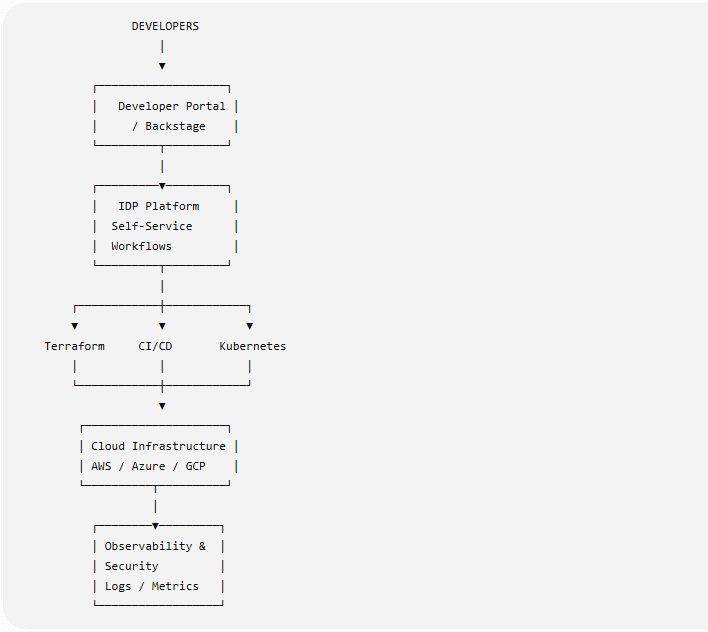
A typical IDP Architecture includes several key layers:
1. Developer Portal
The developer portal acts as the central interface for developers. It can provide application templates, documentation, service catalogs, deployment workflows, infrastructure requests, and monitoring information.
Platforms such as Backstage can be used to create a centralized developer portal.
2. Infrastructure Automation
Infrastructure automation allows platform teams to provision resources consistently. Infrastructure as Code tools such as Terraform can automate the creation and management of cloud resources.
This reduces manual configuration and helps maintain consistency across development, testing, staging, and production environments.
3. Container and Kubernetes Layer
Modern applications increasingly use containers and Kubernetes. An IDP can simplify Kubernetes operations by providing predefined deployment templates and automated workflows.
Developers don’t need to manage every Kubernetes configuration manually. Instead, they can use approved workflows while the platform manages much of the underlying complexity.
4. CI/CD Integration
Continuous integration and continuous deployment are essential parts of an IDP. The platform can integrate with CI/CD tools to automate:
- Code builds and testing
- Container image creation
- Security scanning
- Application deployment
- Rollbacks
This creates a standardized path from code commit to production.
5. Observability and Security
Monitoring, logging, tracing, and security can also be integrated into the platform. Developers can access application metrics, logs, alerts, and dashboards while security policies are enforced through automated workflows.
Internal Developer Platform Architecture Diagram
Key IDP Components
| IDP Component | Purpose | Common Tools |
| Developer Portal | Central interface for developers | Backstage |
| Infrastructure as Code | Automates infrastructure | Terraform |
| Container Platform | Runs applications | Kubernetes, Docker |
| CI/CD | Automates build and deployment | GitHub Actions, Jenkins |
| GitOps | Automates Kubernetes deployments | Argo CD |
| Observability | Monitoring and troubleshooting | Prometheus, Grafana |
| Security | Protects applications and infrastructure | Trivy, Vault |
Key Benefits of an Internal Developer Platform
A well-designed IDP can benefit both developers and infrastructure teams.
Faster Application Delivery
Developers can use predefined workflows instead of waiting for infrastructure teams to manually create resources. This can reduce the time required to move applications from development to production.
Developer Self-Service
One of the biggest advantages of an IDP is Developer Self-Service. Developers can provision approved resources and environments through automated workflows, reducing dependencies on infrastructure teams for routine tasks.
Improved Developer Experience
A well-designed IDP provides developers with clear workflows, templates, documentation, and automation. This allows them to spend more time focusing on application development rather than infrastructure complexity.
Consistency Across Environments
Standardized templates and automated workflows help organizations maintain consistent application and infrastructure configurations across different environments.
Better Security and Governance
Security policies can be incorporated directly into platform workflows. Organizations can enforce access controls, approved container images, vulnerability scanning, secrets management, and other security requirements before applications reach production.
Internal Developer Platform vs Platform Engineering
Although closely connected, an IDP and Platform Engineering are not the same thing.
Platform Engineering is the broader discipline of designing, building, and maintaining internal platforms that improve developer productivity and operational efficiency.
An IDP is one of the key platforms created through this discipline.
The professionals responsible for building and maintaining these platforms are Platform Engineer professionals. They typically work with cloud infrastructure, Kubernetes, automation, CI/CD, security, Infrastructure as Code, and developer experience.
In simple terms:
- Platform Engineering → The discipline
- Platform Infrastructure → The underlying infrastructure and services
- Internal Developer Platform → The platform developers use
- Platform Engineer → The professional who builds and maintains the platform
How to Build an Internal Developer Platform
If you’re wondering How to build an Internal Developer Platform, start with developer requirements rather than technology.
Identify the biggest challenges developers face. Are they waiting too long for infrastructure? Is Kubernetes difficult to manage? Are deployment processes inconsistent? Are teams using different CI/CD workflows?
Once these challenges are identified, the platform team can prioritize the workflows that provide the most value.
Start small instead of attempting to build a large platform immediately. An initial IDP could provide:
- Application templates
- Automated infrastructure provisioning
- CI/CD pipelines
- Kubernetes deployment workflows
- Centralized documentation
- Monitoring and logging
- Security checks
The platform can then evolve based on developer feedback and changing business requirements.
Internal Developer Platforms in 2026
Internal Developer Platforms are evolving as organizations look for faster software delivery, better developer experiences, and more efficient cloud operations. In 2026, IDPs are becoming more automated, intelligent, and product-oriented.
AI-Assisted Development
AI is increasingly becoming part of software development workflows. IDPs can integrate AI-assisted capabilities to help developers generate configurations, troubleshoot deployments, automate repetitive tasks, and improve development workflows.
Self-Service Infrastructure
Self-service infrastructure allows developers to request approved resources, environments, databases, and application infrastructure without manually coordinating with infrastructure teams.
Golden Paths
Golden paths provide recommended and standardized ways for developers to build and deploy applications. For example, an IDP can provide a ready-to-use Kubernetes application template with CI/CD, monitoring, security scanning, and infrastructure provisioning already configured.
Kubernetes Platform Engineering
Kubernetes remains an important foundation for cloud-native applications, making Kubernetes platform engineering a significant part of modern IDP development.
Platform teams can simplify Kubernetes operations for developers while managing cluster configuration, networking, security, observability, and scaling.
Platform-as-a-Product
Organizations are increasingly treating their internal platform as a product rather than simply an infrastructure project.
This Platform-as-a-Product approach means platform teams focus on developers as their internal customers. They collect feedback, measure adoption, improve documentation, and continuously optimize the platform experience.
Built-In Security and Governance
Security and compliance can be integrated directly into platform workflows. Automated policies, access controls, vulnerability scanning, secrets management, and compliance checks can become part of the standard development process.
Cost and FinOps Awareness
Cloud and AI workloads can increase infrastructure costs. As a result, FinOps and cost visibility are becoming increasingly important for platform teams.
An IDP can provide developers with greater visibility into resource consumption and encourage cost-aware infrastructure choices, helping organizations balance developer productivity with efficient cloud spending.
Internal Developer Platform Best Practices
Following Internal Developer Platform best practices can help organizations build a platform that developers actually want to use.
Keep the Developer Experience Simple
The platform should reduce complexity rather than introduce another complicated system. Workflows should be intuitive and require minimal infrastructure knowledge.
Build Reusable Templates
Standardized templates allow developers to create applications using approved configurations. Templates can include infrastructure definitions, CI/CD pipelines, security policies, and monitoring configurations.
Automate Wherever Possible
Automate infrastructure provisioning, deployments, testing, security checks, and other repetitive operational tasks wherever practical.
Treat the Platform as a Product
An IDP should be continuously improved based on developer feedback. Platform teams should monitor adoption, identify friction points, improve documentation, and introduce useful capabilities over time.
Don’t Hide Everything
An IDP should simplify infrastructure without turning it into a black box. Developers should still have the visibility and information required to understand and troubleshoot their applications.
The Role of Platform Engineers
A Platform Engineer needs a combination of software engineering and infrastructure skills.
Depending on the organization, platform engineers may work with Kubernetes, Docker, Terraform, AWS, Azure, GitOps, CI/CD, monitoring, security, and cloud-native technologies.
They also need to understand developer workflows because the platform ultimately exists to support development teams.
This makes platform engineering different from traditional infrastructure administration. The focus is not only on maintaining infrastructure but also on creating scalable, automated, secure, and developer-friendly systems.
How Platform Engineering Services Can Help
Building an IDP requires expertise across cloud infrastructure, Kubernetes, automation, security, CI/CD, and DevOps.
Organizations that don’t have an internal platform team can work with providers offering Platform engineering services to design, implement, and optimize their internal developer platforms.
These services can include Kubernetes platform implementation, cloud infrastructure automation, Infrastructure as Code, CI/CD implementation, GitOps, monitoring, security automation, and ongoing platform management.
The right approach depends on the organization’s application architecture, cloud environment, development workflows, security requirements, and business goals.
Final Verdict
An Internal Developer Platform (IDP) can help organizations reduce infrastructure complexity while giving developers faster and more consistent ways to build and deploy applications.
However, a successful IDP is more than a collection of tools. Its value comes from combining automation, infrastructure, security, and developer experience into a platform that solves real development challenges.
By following Internal Developer Platform best practices, focusing on developer needs, and continuously improving the platform, organizations can create a scalable foundation for modern software delivery.
For organizations adopting Kubernetes, cloud-native technologies, and modern DevOps practices, an IDP can be an important step toward building a more productive, secure, and efficient engineering environment.
Build a Scalable Internal Developer Platform With Geeks Solutions
Ready to simplify infrastructure, accelerate software delivery, and give your development teams a better self-service experience?
Geeks Solutions helps businesses design and implement modern Platform Engineering solutions built around Kubernetes, AWS, Azure, Terraform, CI/CD, GitOps, automation, security, and observability.
Whether you’re planning your first Internal Developer Platform (IDP) or looking to improve an existing platform, our experts can help you build a secure, scalable, and developer-friendly platform aligned with your business requirements.
Talk to our Platform Engineering experts today and discover how an Internal Developer Platform can transform your development and infrastructure workflows.
Contact Geeks Solutions to discuss your Platform Engineering requirements.
Frequently Asked Questions
1. What is an Internal Developer Platform (IDP)?
An Internal Developer Platform (IDP) is a collection of tools, services, automation, and workflows that enables developers to build, deploy, and manage applications through standardized self-service processes.
2. What are the benefits of an Internal Developer Platform?
The main benefits of an Internal Developer Platform include faster application delivery, developer self-service, improved developer experience, standardized workflows, better security, and reduced infrastructure complexity.
3. What tools are used to build an Internal Developer Platform?
Common Internal Developer Platform tools include Backstage for developer portals, Terraform for infrastructure automation, Kubernetes for container orchestration, GitHub Actions or Jenkins for CI/CD, Argo CD for GitOps, and Prometheus and Grafana for observability.
4. How do you build an Internal Developer Platform?
To build an Internal Developer Platform, organizations should first identify developer challenges, then create self-service workflows using infrastructure automation, CI/CD, Kubernetes, security, monitoring, and reusable application templates. The platform should start small and evolve based on developer feedback.
5. What is the difference between Platform Engineering and an IDP?
Platform Engineering is the discipline of designing and managing internal platforms, while an Internal Developer Platform (IDP) is the platform that provides developers with self-service tools, automation, and standardized workflows.