Running a modern restaurant or retail chain means every second of downtime costs revenue. Industry research estimates that IT downtime can cost organizations thousands of dollars per hour, while retail customers increasingly expect fast, uninterrupted checkout experiences across physical stores, kiosks, and online channels. A single POS outage during peak business hours can lead to lost sales, frustrated customers, and operational chaos.
What is Kubernetes for POS Applications?
Kubernetes for POS Applications is the practice of deploying, managing, and scaling Point-of-Sale (POS) platforms using Kubernetes to ensure high availability, automated scaling, rapid deployments, and resilient infrastructure. It enables restaurants and retailers to operate cloud-native POS systems that remain available even during traffic spikes or infrastructure failures.
Why Businesses Are Moving POS Applications to Kubernetes
Traditional POS applications were designed for static servers, making them difficult to scale during seasonal demand, promotions, or multi-location expansion.
Modern businesses require:
- Continuous uptime
- Automatic failover
- Rapid software deployments
- Secure infrastructure
- Multi-location consistency
- Cloud-native scalability
This is where Kubernetes for POS Applications becomes a strategic technology investment rather than simply an infrastructure upgrade.
According to CNCF’s annual survey, more than 96% of organizations are using or evaluating Kubernetes, making it the industry’s leading orchestration platform for cloud-native workloads. Gartner also predicts that over 95% of new digital workloads will be deployed on cloud-native platforms by 2028, highlighting the accelerating shift toward Kubernetes-powered applications.
Why It Matters
POS systems are mission-critical.
Whether processing restaurant orders or retail transactions, every second of downtime directly impacts revenue.
Without a resilient platform, businesses often experience:
- Checkout failures during peak hours
- Slow application performance
- Database bottlenecks
- Store synchronization issues
- Manual infrastructure management
- Difficult software upgrades
- Increased security risks
A High Availability POS Infrastructure ensures uninterrupted operations while reducing operational complexity.
How Kubernetes Works for POS Applications
Step 1: Containerize the POS Platform
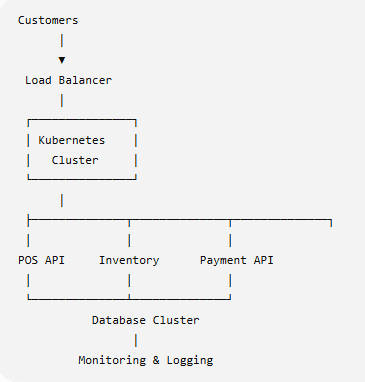
The POS application, payment gateway integrations, APIs, inventory services, loyalty programs, and reporting services are packaged into independent containers.
Each component becomes easier to deploy, update, and manage.
Step 2: Kubernetes Orchestrates Every Service
Kubernetes automatically:
- Deploys containers
- Monitors application health
- Restarts failed services
- Performs rolling updates
- Balances workloads
- Scales resources automatically
This significantly reduces manual intervention.
Step 3: Intelligent Auto Scaling
During busy periods like:
- Weekend restaurant rush
- Black Friday
- Holiday shopping
- Festival sales
- Flash promotions
Kubernetes automatically launches additional application instances.
When traffic decreases, unnecessary resources are removed to optimize cloud costs.
This makes Scaling Retail POS Applications with Kubernetes highly efficient and cost-effective.
Step 4: High Availability
If one server fails:
- Kubernetes detects the issue
- Starts replacement containers
- Redirects traffic automatically
- Maintains uninterrupted service
Customers continue placing orders without noticing infrastructure failures.
Architecture Overview
Benefits of Kubernetes for Restaurant & Retail POS Platforms
1. Zero Downtime Deployments
Software updates occur without interrupting customer transactions using rolling updates.
Restaurants can deploy new menu items without shutting down their ordering system.
2. Automatic Scaling
Cloud resources increase only when required.
This prevents over-provisioning while maintaining excellent customer experience.
3. Better Disaster Recovery
Applications recover automatically after:
- Server failures
- Hardware issues
- Cloud zone outages
- Node crashes
4. Stronger Security
Modern Kubernetes environments support:
- Network Policies
- Secrets Management
- RBAC
- Image Scanning
- Policy Enforcement
These controls strengthen payment system security and compliance.
5. Multi-Location Management
Restaurant chains and retail brands can manage hundreds of locations from centralized Kubernetes clusters while maintaining consistent deployments.
Real-World Example 1: Restaurant Chain
A restaurant franchise operating 250 locations experienced POS slowdowns every Friday evening.
After implementing Kubernetes for Restaurant POS Systems, they achieved:
- Automatic traffic scaling
- Zero-downtime deployments
- Faster kitchen order processing
- Centralized software updates
- Improved customer experience during peak dining hours
Store managers no longer needed manual application restarts.
Real-World Example 2: Retail Enterprise
A national retail brand migrated its legacy POS platform to a Cloud-Native POS Applications architecture running on Kubernetes.
Results included:
- Faster software releases
- High availability across stores
- Reduced infrastructure costs
- Improved inventory synchronization
- Better resilience during seasonal promotions
The platform handled holiday shopping traffic without performance degradation.
Why Managed Kubernetes Services Make Sense
Many organizations lack experienced Kubernetes administrators.
This is where Managed Kubernetes Services provide significant value.
A managed team typically handles:
- Cluster deployment
- Security hardening
- Monitoring
- Backup management
- Performance optimization
- Version upgrades
- Incident response
- Capacity planning
This allows IT teams to focus on improving business applications instead of infrastructure management.
When Should You Consider Kubernetes Consulting Services?
Organizations often engage Kubernetes Consulting Services when they need to:
- Modernize legacy POS applications
- Migrate from virtual machines
- Improve application availability
- Reduce cloud costs
- Build multi-cloud deployments
- Implement DevOps automation
- Design scalable cloud-native architectures
Experienced consultants help avoid costly architectural mistakes while accelerating production readiness.
Best Practices for Kubernetes-Based POS Infrastructure
Build Stateless Application Services
Keep business logic independent from infrastructure for easier scaling.
Use Horizontal Pod Autoscaling
Automatically adjust resources based on CPU, memory, or custom metrics.
Deploy Across Multiple Availability Zones
Improve resilience against infrastructure failures.
Implement Continuous Monitoring
Track:
- Application latency
- Transaction failures
- Cluster health
- Resource utilization
- Payment API response times
Secure Every Layer
Follow Kubernetes security best practices including:
- Least privilege RBAC
- Encrypted secrets
- Image vulnerability scanning
- Admission policies
- Network segmentation
Automate CI/CD
Deploy updates safely using GitOps or automated pipelines to reduce deployment risks.
Final Verdict
As restaurants and retailers continue embracing digital transformation, infrastructure resilience becomes just as important as application functionality. Kubernetes for POS Applications provides the scalability, automation, and reliability needed to support high transaction volumes, distributed locations, and always-on customer experiences.
Combining Managed Kubernetes Services, Kubernetes Consulting Services, Kubernetes Support Services, and a well-designed High Availability POS Infrastructure enables organizations to modernize legacy systems, accelerate deployments, strengthen security, and confidently scale Cloud-Native POS Applications for future growth.
Ready to Modernize Your POS Infrastructure?
Whether you’re operating a fast-growing restaurant chain, a multi-store retail business, or building the next generation of Cloud-Native POS Applications, our Kubernetes specialists can help you design, migrate, optimize, and manage a resilient platform tailored to your business goals.
Partner with our certified Kubernetes experts to build a highly available, secure, and scalable POS platform that minimizes downtime, accelerates innovation, and delivers seamless customer experiences while your team stays focused on growing the business.
Frequently Asked Questions:
Kubernetes for POS Applications is the use of Kubernetes to deploy, manage, and scale Point-of-Sale systems in restaurants and retail stores. It automatically manages application availability, load balancing, self-healing, and scaling, ensuring uninterrupted checkout experiences even during peak shopping hours. Businesses adopting Kubernetes for Restaurant POS Systems benefit from improved uptime, faster software deployments, lower operational costs, and greater infrastructure resilience.
Scaling Retail POS Applications with Kubernetes enables businesses to automatically increase or decrease computing resources based on transaction volumes. During high-demand periods such as Black Friday, holiday sales, or weekend restaurant rushes, Kubernetes creates additional application instances to handle customer traffic without performance degradation. This approach ensures faster checkout, reduced latency, and optimized cloud resource utilization.
Managed Kubernetes Services for POS applications help businesses reduce operational complexity by outsourcing cluster management, security updates, monitoring, backup, disaster recovery, and performance optimization. Instead of maintaining Kubernetes infrastructure internally, organizations can focus on improving customer experience while certified experts ensure high availability, compliance, and continuous platform reliability.
Yes. Cloud-Native POS Applications running on Kubernetes are ideal for restaurant chains and retail enterprises with multiple locations. Kubernetes enables centralized application management, zero-downtime software deployments, automatic failover, and consistent updates across all branches. This architecture improves operational efficiency while reducing maintenance overhead and infrastructure downtime.
The best practices for building a High Availability POS Infrastructure with Kubernetes include deploying workloads across multiple availability zones, enabling Horizontal Pod Autoscaling, implementing rolling updates, securing workloads with RBAC and Network Policies, monitoring clusters using Prometheus and Grafana, automating deployments with CI/CD pipelines, and regularly backing up application data. Following these practices helps ensure business continuity, security, and uninterrupted customer transactions.