The Hidden Cost of Poor Cloud Planning
According to Gartner, more than 70% of enterprises will use industry cloud platforms by 2028, yet many cloud migration projects still exceed budgets, face delays, or fail to deliver expected outcomes due to inadequate preparation.
The biggest reason isn’t technology, it’s lack of readiness.
A Cloud Migration Checklist is a structured framework that helps organizations evaluate infrastructure, applications, security, compliance, costs, and operational readiness before moving workloads to the cloud. It reduces migration risks, prevents downtime, and ensures a smoother transition to modern cloud environments.
Why Cloud Migration Readiness Matters
Enterprise cloud adoption is no longer optional. Organizations are moving critical workloads to the cloud to improve scalability, resilience, performance, and operational efficiency.
However, migration without a clear roadmap often leads to:
- Unexpected costs
- Application compatibility issues
- Security vulnerabilities
- Downtime during migration
- Compliance violations
- Poor cloud performance
A comprehensive Cloud Migration Readiness assessment helps enterprises identify these risks before migration begins.
Enterprise Cloud Migration Readiness Checklist
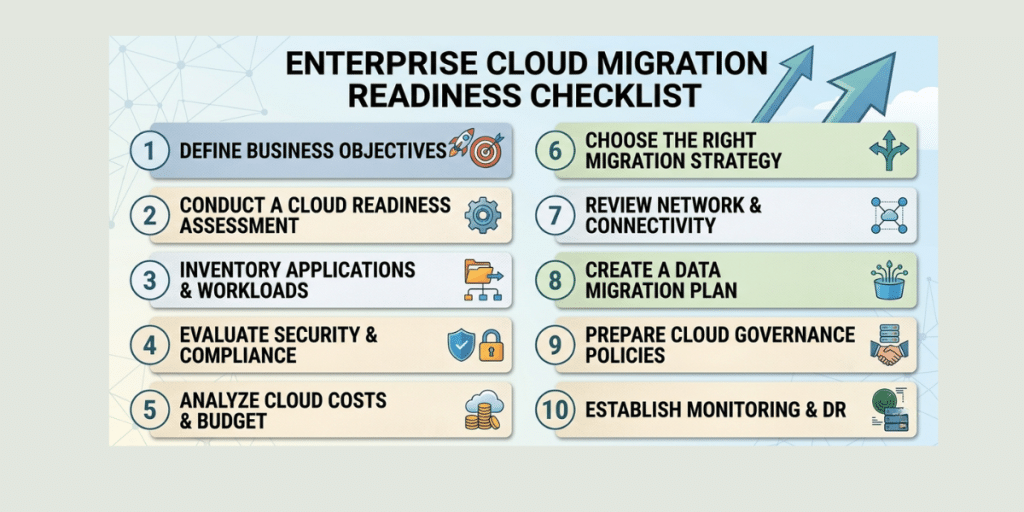
1. Define Business Objectives
Before evaluating technology, define why the organization is migrating.
Ask questions such as:
- What business outcomes are expected?
- Is the goal cost optimization?
- Improved disaster recovery?
- Better scalability?
- Faster application deployment?
Migration decisions should always align with business goals rather than infrastructure trends.
Key Deliverables
- Migration goals
- Expected ROI
- Timeline
- Success metrics
2. Conduct a Cloud Readiness Assessment
A thorough Cloud Readiness Assessment evaluates whether existing infrastructure, applications, processes, and teams are prepared for migration.
Assess:
Infrastructure Readiness
- Server inventory
- Storage utilization
- Network architecture
- Database dependencies
Operational Readiness
- Monitoring capabilities
- Backup strategies
- Incident response procedures
Organizational Readiness
- Cloud skills availability
- Governance policies
- Change management process
A detailed assessment helps avoid surprises during migration.
3. Inventory Applications and Workloads
Not every workload belongs in the cloud.
Create a complete application inventory including:
- Business criticality
- Resource consumption
- Performance requirements
- Security requirements
- Dependencies
Categorize Applications
| Category | Migration Approach |
| Legacy Apps | Refactor or Replace |
| Modern Applications | Rehost or Replatform |
| Mission-Critical Systems | Phased Migration |
| Development Environments | Immediate Migration |
Understanding dependencies is critical for successful Enterprise Cloud Migration.
4. Evaluate Security and Compliance Requirements
Security should never be treated as an afterthought.
According to IBM’s Cost of a Data Breach Report, cloud misconfigurations remain one of the leading causes of security incidents.
Review:
- Identity and Access Management (IAM)
- Encryption requirements
- Security policies
- Audit controls
- Compliance obligations
Common Compliance Frameworks
- GDPR
- HIPAA
- PCI DSS
- ISO 27001
- SOC 2
A proactive security review significantly reduces migration risks.
5. Analyze Cloud Costs and Budget
Many organizations underestimate cloud spending.
Before migration, calculate:
Direct Costs
- Compute resources
- Storage
- Network bandwidth
- Licensing
Indirect Costs
- Training
- Migration tools
- Professional services
- Operational changes
Use cloud cost calculators and forecasting tools to estimate Total Cost of Ownership (TCO).
A successful Cloud Migration Strategy balances performance and cost optimization.
6. Choose the Right Migration Strategy
Every workload requires a different migration approach.
The 6 Rs of Cloud Migration
Rehost
Lift-and-shift migration with minimal changes.
Replatform
Minor optimizations during migration.
Refactor
Redesign applications for cloud-native architecture.
Repurchase
Move to SaaS alternatives.
Retire
Eliminate unnecessary workloads.
Retain
Keep workloads on-premises.
Selecting the right strategy reduces complexity and improves ROI.
7. Review Network and Connectivity Requirements
Network performance directly impacts cloud success.
Assess:
- VPN requirements
- Dedicated cloud connectivity
- Latency expectations
- Bandwidth requirements
- Traffic patterns
Poor network planning often becomes a bottleneck after migration.
8. Create a Data Migration Plan
Data is usually the most sensitive component of migration.
Evaluate:
- Data volume
- Data sensitivity
- Migration windows
- Backup requirements
- Validation procedures
Best Practices
- Perform test migrations
- Maintain backups
- Validate data integrity
- Implement rollback plans
Data accuracy is critical for business continuity.
9. Prepare Cloud Governance Policies
Without governance, cloud environments become difficult to manage.
Develop policies for:
- Resource provisioning
- Security controls
- Cost management
- Access management
- Compliance monitoring
Strong governance supports long-term cloud success.
10. Establish Monitoring and Disaster Recovery
Migration is only the beginning.
Implement:
Monitoring
- Infrastructure monitoring
- Application monitoring
- Log management
- Performance analytics
Disaster Recovery
- Automated backups
- Multi-region replication
- Recovery testing
- Business continuity plans
Organizations with tested disaster recovery plans recover significantly faster from outages.
Real-World Enterprise Cloud Migration Example
A global financial services company operating across multiple regions faced rising infrastructure costs and inconsistent application performance.
Challenges
- 400+ virtual machines
- Legacy databases
- Regulatory compliance requirements
- Limited scalability
Migration Approach
The organization conducted a complete Enterprise Cloud Migration Checklist review before migration.
Key actions included:
- Cloud readiness assessment
- Application dependency mapping
- Security audit
- Disaster recovery redesign
- Cost optimization planning
Results
- 35% reduction in infrastructure costs
- 50% faster application deployment
- Improved disaster recovery capabilities
- Enhanced compliance visibility
The success was largely attributed to extensive pre-migration planning rather than the migration process itself.
Emerging Trends Shaping Cloud Migration in 2026 and Beyond
Enterprise cloud adoption continues to evolve rapidly.
AI-Powered Migration Tools
Artificial intelligence is helping organizations automate workload discovery, dependency mapping, and migration planning.
Multi-Cloud Strategies
Enterprises increasingly use multiple cloud providers to improve resilience and avoid vendor lock-in.
Cloud-Native Modernization
Organizations are moving beyond lift-and-shift toward Kubernetes, containers, and microservices.
FinOps Adoption
Cloud cost governance has become a strategic priority for CFOs and IT leaders.
Security-First Cloud Architectures
Zero Trust security models are becoming standard for enterprise cloud environments.
These trends are transforming how organizations approach Cloud Migration Services and long-term cloud operations.
Final verdict
A successful cloud migration begins long before the first workload moves to the cloud.
Following a structured Cloud Migration Checklist helps enterprises reduce risk, improve security, control costs, and accelerate business outcomes. Organizations that invest in readiness assessments consistently achieve better migration success rates than those that rush into implementation.
Ready to Accelerate Your Cloud Journey?
Before investing in migration tools or cloud infrastructure, evaluate your readiness first. A comprehensive assessment can uncover hidden risks, identify cost-saving opportunities, and create a roadmap that ensures a faster, safer, and more profitable cloud transformation.
Frequently Asked Questions
1. What is an Enterprise Cloud Migration Checklist?
An Enterprise Cloud Migration Checklist is a structured framework used to evaluate infrastructure, applications, security, compliance, costs, and operational readiness before moving workloads to the cloud.
2. How do you assess cloud migration readiness?
A Cloud Readiness Assessment involves analyzing current infrastructure, application dependencies, security controls, compliance requirements, network architecture, and organizational capabilities to determine migration preparedness.
3. What are the most important steps in a cloud migration planning checklist for enterprises?
The most critical steps include workload assessment, security review, cost analysis, application dependency mapping, migration strategy selection, governance planning, and disaster recovery preparation.
4. Why is a cloud readiness assessment important before migration?
A Cloud Readiness Assessment Checklist for Businesses helps identify risks, reduce downtime, improve security, optimize costs, and ensure a smoother migration process.
5. What is the best cloud migration strategy for enterprises?
The best Cloud Migration Strategy depends on workload requirements and business goals. Organizations commonly use rehosting, replatforming, refactoring, retiring, retaining, or repurchasing approaches based on application complexity and modernization needs.