Introduction
Why Companies Investing in DevOps Deliver Software Up to 208 Times Faster
Organizations that embrace DevOps Implementation Services can deploy software up to 208 times more frequently and recover from failures 106 times faster than traditional IT teams. Yet many businesses still struggle with slow deployments, infrastructure inconsistencies, security vulnerabilities, and costly downtime.
If your software releases take weeks instead of hours, or your teams are battling manual processes and operational bottlenecks, a modern DevOps strategy can transform the way you build, deploy, and manage applications.
What Are DevOps Implementation Services?
DevOps Implementation Services are professional consulting and engineering services that help organizations automate software development, infrastructure provisioning, testing, security, deployment, and monitoring. These services enable businesses to accelerate software delivery, improve reliability, enhance security, and scale efficiently across cloud platforms such as AWS, Azure, and Google Cloud.
In simple terms, DevOps bridges the gap between development and operations teams through automation, collaboration, and cloud-native technologies.
Why DevOps Matters More Than Ever
Modern businesses are expected to release new features faster while maintaining security and reliability.
According to industry research:
- High-performing DevOps teams deploy software up to 208 times more frequently.
- Organizations implementing DevOps reduce change failure rates by up to 7 times.
- Companies adopting cloud-native DevOps practices report infrastructure cost reductions of 30–40%.
- Gartner predicts that cloud spending will continue to exceed hundreds of billions annually as digital transformation accelerates.
These numbers highlight why Cloud DevOps Services have become a strategic business investment rather than just an IT initiative.
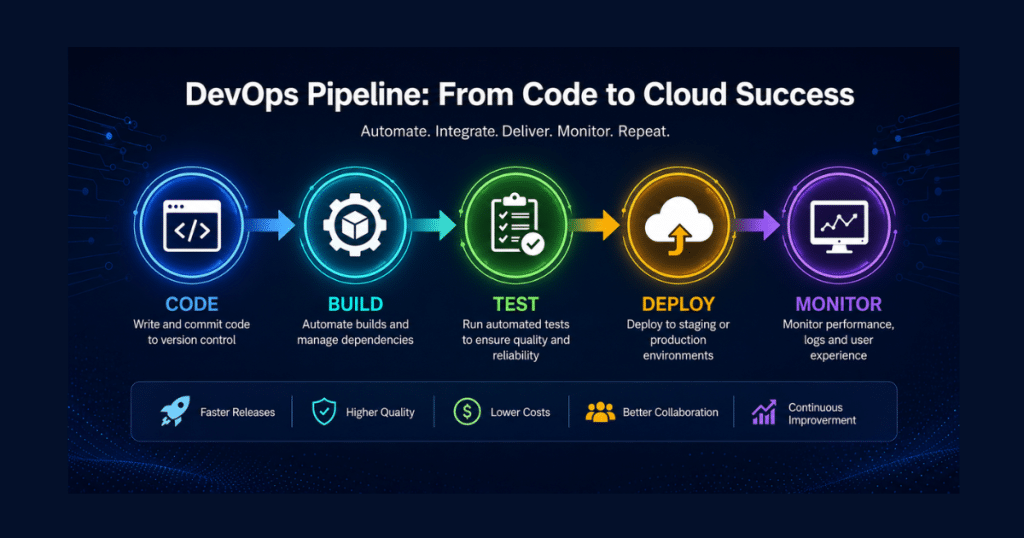
How DevOps Implementation Services Improve Software Delivery
One of the primary goals of DevOps Consulting Services is to streamline the entire software delivery lifecycle.
Benefits include:
Faster Release Cycles
Automated workflows eliminate manual bottlenecks.
- Continuous Integration
- Automated Testing
- Continuous Delivery
- Automated Rollbacks
Improved Application Reliability
Monitoring and observability tools provide real-time insights into application health.
Reduced Downtime
Automation minimizes human error during deployments.
Enhanced Security
Security is integrated throughout the development lifecycle using DevSecOps Integration practices.
Better Team Collaboration
Developers, operations, security, and QA teams work from a unified platform.
Key Components of End-to-End DevOps Implementation Services for Businesses
A successful DevOps transformation includes multiple interconnected components.
1. CI/CD Pipeline Implementation
CI/CD Pipeline Implementation automates the process of building, testing, and deploying applications.
Benefits:
- Faster deployments
- Reduced deployment failures
- Improved code quality
- Consistent release processes
Popular tools include:
- Jenkins
- GitHub Actions
- GitLab CI/CD
- Azure DevOps
- CircleCI
Pro Tip
Start with one critical application and perfect the pipeline before expanding organization-wide.
2. Infrastructure as Code (IaC)
Infrastructure as Code (IaC) allows infrastructure to be managed using code instead of manual configurations.
Popular IaC tools:
- Terraform
- AWS CloudFormation
- Pulumi
- Ansible
Benefits:
- Repeatable environments
- Faster provisioning
- Version-controlled infrastructure
- Simplified disaster recovery
3. Cloud DevOps Services
Modern DevOps strategies rely heavily on cloud platforms.
Key cloud DevOps capabilities include:
- Auto-scaling infrastructure
- Container orchestration
- Serverless deployments
- Cloud-native monitoring
- Multi-region deployment strategies
4. DevSecOps Integration
Security must be embedded into every stage of software delivery.
DevSecOps Best Practices
- Automated vulnerability scanning
- Security code analysis
- Container security checks
- Secrets management
- Compliance automation
Popular tools:
- Trivy
- Snyk
- SonarQube
- Aqua Security
- HashiCorp Vault
5. Monitoring and Observability
You cannot optimize what you cannot measure.
Leading observability tools:
- Prometheus
- Grafana
- Datadog
- New Relic
- Elastic Stack
Benefits:
- Faster issue detection
- Improved user experience
- Reduced Mean Time to Recovery (MTTR)
- Better capacity planning
DevOps Implementation for AWS, Azure, and Google Cloud
Different cloud platforms provide unique DevOps capabilities.
| Platform | DevOps Services | Popular Tools |
| AWS | Cloud-native automation, Kubernetes, CI/CD | CodePipeline, EKS, CloudFormation |
| Azure | Enterprise DevOps workflows | Azure DevOps, AKS |
| Google Cloud | Container-first DevOps environments | Cloud Build, GKE |
AWS DevOps Implementation
Ideal for organizations requiring scalability, automation, and cloud-native application development.
Azure DevOps Implementation
Best suited for enterprises leveraging Microsoft ecosystems.
Google Cloud DevOps Services
Excellent for Kubernetes-driven and containerized workloads.
DevOps Automation Services: Eliminating Manual Operations
Manual processes increase costs, delays, and errors.
DevOps Automation Services help organizations automate:
- Infrastructure provisioning
- Application deployment
- Security testing
- Performance testing
- Configuration management
- Monitoring and alerting
Automation improves consistency while reducing operational overhead.
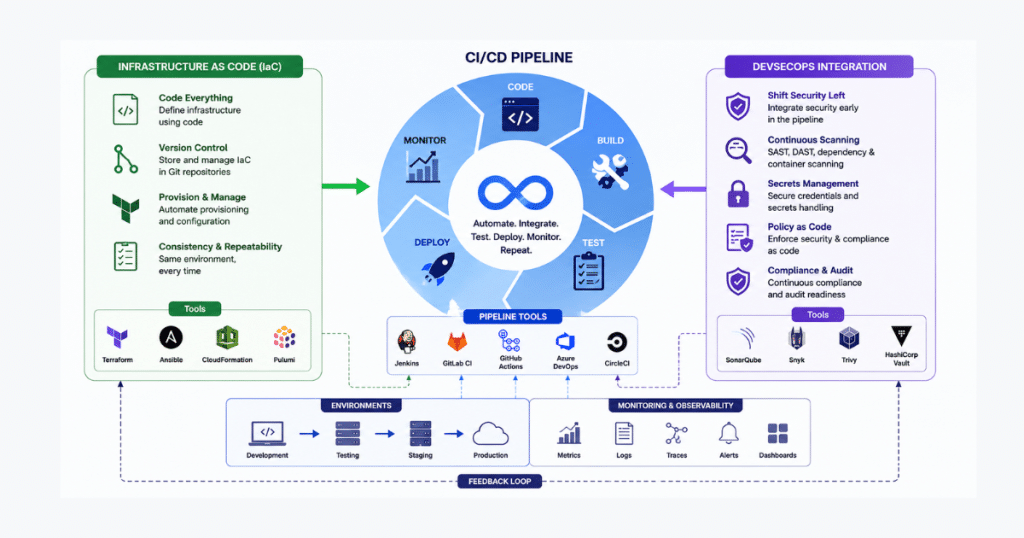
Enterprise DevOps Implementation Best Practices
Successful enterprise DevOps initiatives follow proven strategies.
1. Align DevOps with Business Goals
Focus on outcomes rather than tools.
2. Standardize Deployment Pipelines
Create reusable deployment frameworks.
3. Implement Infrastructure as Code
Avoid configuration drift.
4. Shift Security Left
Integrate security from the beginning.
5. Adopt GitOps Principles
Use Git as the single source of truth.
6. Measure DevOps Performance
Track:
- Deployment Frequency
- Lead Time for Changes
- Change Failure Rate
- Mean Time to Recovery (MTTR)
These are known as DORA Metrics and are considered the gold standard for DevOps performance measurement.
DIY DevOps vs Managed DevOps Consulting Services
| Factor | DIY DevOps | Managed DevOps Services |
| Setup Time | 3–6 Months | 2–6 Weeks |
| Expertise | Internal Hiring Required | Certified Experts Included |
| Cost Predictability | Variable | Fixed Monthly Plans |
| Security | Often Reactive | Built-in DevSecOps |
| Scalability | Limited Resources | Enterprise Grade |
| Support | Internal Team | 24×7 Monitoring |
For most organizations, managed DevOps Consulting Services provide faster ROI and lower operational risk.
Real-World DevOps Success Story
FinTech Company Accelerates Releases by 10x
A growing fintech organization struggled with lengthy release cycles and manual deployment processes.
After implementing:
- CI/CD pipelines
- Kubernetes automation
- Infrastructure as Code
- DevSecOps Integration
Results achieved:
- Deployment time reduced from weeks to hours
- 60% reduction in production incidents
- 35% reduction in cloud costs
- Faster regulatory compliance audits
Common DevOps Implementation Mistakes to Avoid
Avoid these costly mistakes:
- Treating DevOps as a tool rather than a culture
- Ignoring monitoring and observability
- Delaying security integration
- Overcomplicating initial automation efforts
- Lack of measurable KPIs
- Choosing providers based solely on cost
- Poor documentation practices
Why Businesses Invest in DevOps Consulting Services
Organizations choose DevOps Consulting Services because they provide:
- Faster software delivery
- Lower infrastructure costs
- Improved security posture
- Better customer experience
- Reduced downtime
- Increased operational efficiency
- Scalable cloud environments
A professional DevOps partner helps avoid years of trial and error while accelerating business outcomes.
Conclusion: The Future Belongs to Automated, Cloud-Native Organizations
This Complete Guide to DevOps Implementation Services demonstrates why modern businesses are investing heavily in automation, cloud-native infrastructure, and continuous delivery practices.
Whether you’re modernizing legacy systems, migrating to the cloud, implementing Kubernetes, or building enterprise-grade CI/CD pipelines, the right DevOps strategy can dramatically improve speed, reliability, security, and scalability.
Businesses that embrace Cloud DevOps Services, Infrastructure as Code (IaC), CI/CD Pipeline Implementation, and DevSecOps Integration today will be better positioned to compete, innovate, and grow tomorrow.
Accelerate Your Cloud Transformation with Expert DevOps Implementation Services
Your competitors are already automating software delivery, optimizing cloud infrastructure, and deploying applications faster than ever.
At 24x7ServerManagement, our certified DevOps engineers help organizations implement end-to-end DevOps solutions across AWS, Azure, Google Cloud, Kubernetes, and hybrid environments.
From cloud migration and CI/CD automation to Infrastructure as Code, DevSecOps, and 24×7 monitoring, we deliver measurable business outcomes that reduce costs and accelerate growth.
Schedule a DevOps assessment today and discover how modern DevOps implementation can transform your software delivery and cloud operations.
Frequently Asked Questions
DevOps Implementation Services help organizations automate software development, testing, deployment, monitoring, and infrastructure management. By implementing CI/CD pipelines, Infrastructure as Code (IaC), and DevSecOps practices, businesses can accelerate releases, reduce downtime, and improve software quality.
How DevOps implementation services improve software delivery depends on automation and collaboration. These services eliminate manual deployment processes, automate testing, improve code quality, and enable continuous delivery, allowing businesses to release applications faster and more reliably.
End-to-end DevOps implementation services for businesses provide complete automation across development, infrastructure, security, and operations. Benefits include faster deployment cycles, lower operational costs, improved security, enhanced scalability, and better team collaboration.
DevOps implementation for AWS, Azure, and Google Cloud varies based on the tools and services available on each platform. AWS uses services like CodePipeline and EKS, Azure relies on Azure DevOps and AKS, while Google Cloud offers Cloud Build and GKE. All three support CI/CD, Infrastructure as Code, and cloud-native automation.
Enterprise DevOps implementation best practices include adopting Infrastructure as Code (IaC), implementing CI/CD pipelines, integrating DevSecOps security controls, establishing observability, using GitOps workflows, and continuously measuring DORA metrics such as deployment frequency and mean time to recovery.