Summary
Modern cyber threats are no longer predictable or isolated. As organizations adopt cloud computing, remote work, and DevOps-driven development, attackers are leveraging automation, AI, and sophisticated techniques to breach systems faster than ever. Traditional, rule-based cybersecurity tools struggle to keep pace with this evolving threat landscape.
This blog explores how AI-powered cybersecurity, smart threat detection, and machine learning-based security analytics are transforming the way enterprises detect, prevent, and respond to cyberattacks. It explains the technologies behind intelligent threat detection, real-world enterprise use cases, and best practices for implementing AI-driven security across cloud and DevOps environments—helping organizations build a proactive, resilient, and future-ready security posture.
AI Meets Cybersecurity: The Rise of Smart Threat Detection
Introduction: Why Cybersecurity Needs Intelligence, Not Just Rules
Cybersecurity has entered a new era. With cloud-native applications, hybrid workforces, and API-driven ecosystems becoming the norm, the attack surface has expanded dramatically. Cybercriminals are no longer relying solely on brute-force attacks or known malware signatures. Instead, they exploit misconfigurations, behavioral loopholes, and zero-day vulnerabilities.
Traditional security tools depend heavily on static rules and predefined signatures. While effective in the past, these systems failed to detect novel or fast-moving threats. This gap has accelerated the adoption of AI-driven threat detection, which enables organizations to analyze massive volumes of data, identify abnormal behavior, and respond to threats in real time.
What Is Smart Threat Detection?
Smart threat detection refers to the use of artificial intelligence, machine learning, and behavioral analytics to identify potential cyber threats dynamically. Unlike legacy systems that rely on known attack patterns, AI-based solutions learn what “normal” looks like and flag deviations instantly.
Key capabilities include:
- Continuous behavioral monitoring
- Anomaly detection across users, networks, and workloads
- Context-aware alerts instead of noisy false positives
- Automated or semi-automated incident response
This intelligent approach allows security teams to detect unknown threats before damage occurs.
How AI Is Transforming Cybersecurity Operations
AI fundamentally changes how cybersecurity teams operate by shifting from reactive defense to predictive and adaptive protection.
AI systems can:
- Analyze logs, telemetry, and network traffic at scale
- Detect subtle indicators of compromise
- Prioritize threats based on risk and impact
- Reduce alert fatigue through intelligent correlation
By automating repetitive tasks, AI-powered security monitoring enables security teams to focus on strategic risk management and faster remediation.
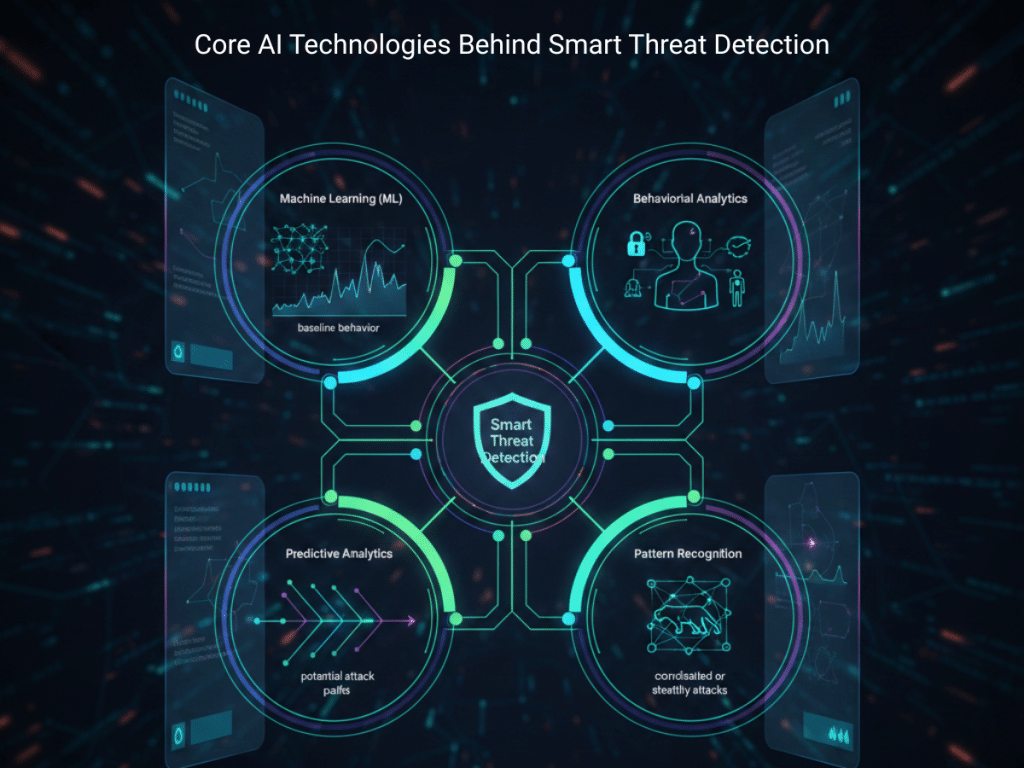
Core AI Technologies Behind Smart Threat Detection
Several AI technologies work together to power intelligent cybersecurity systems:
- Machine Learning (ML): Learns baseline behavior and identifies anomalies
- Behavioral Analytics: Detects insider threats and compromised credentials
- Predictive Analytics: Anticipates potential attack paths
- Pattern Recognition: Identifies coordinated or stealthy attacks
These technologies allow cybersecurity systems to evolve continuously as threats change.
Real-World Example: AI in Action
Consider a mid-sized enterprise running customer-facing applications on a multi-cloud environment with automated CI/CD pipelines.
During routine operations, an AI-based security system detects unusual API call patterns originating from a developer account outside normal working hours. While traditional tools see no known malware signature, the AI system identifies behavioral anomalies—sudden privilege escalation and abnormal data access.
Within minutes, automated controls isolate the affected workload, revoke compromised credentials, and alert the security team with a clear risk assessment. What could have become a major data breach is contained early—demonstrating the real-world value of AI-powered threat detection.
AI-Powered Security in Cloud and DevOps Environments
Modern infrastructures rely heavily on containers, microservices, and automated pipelines. While this accelerates innovation, it also introduces security complexity.
AI strengthens cloud and DevOps security by:
- Monitoring Kubernetes clusters and cloud workloads in real time
- Detecting misconfigurations and excessive permissions
- Identifying supply chain and CI/CD pipeline threats
- Tracking lateral movement across cloud resources
This approach supports DevSecOps practices, ensuring security keeps pace with rapid development cycles.
Business Benefits of AI-Driven Cybersecurity
Organizations adopting intelligent cybersecurity solutions gain measurable advantages:
- Faster threat detection and response times
- Reduced operational burden on security teams
- Improved accuracy with fewer false alerts
- Scalability across hybrid and multi-cloud environments
- Continuous compliance and audit readiness
For enterprises handling sensitive data, these benefits translate directly into reduced risk and improved trust.
Challenges and Limitations of AI in Cybersecurity
Despite its strengths, AI is not a silver bullet. Organizations must consider:
- Data quality and visibility across environments
- Model transparency and explainability
- Integration with existing security tools
- The need for human oversight in decision-making
A hybrid approach—combining AI-driven automation with experienced security professionals—delivers the most effective results.
Best Practices for Implementing Smart Threat Detection
To maximize success with AI-based security:
- Embed security early in cloud and DevOps workflows
- Ensure visibility across infrastructure, applications, and users
- Continuously train and fine-tune AI models
- Align security insights with business risk priorities
- Combine automated responses with human validation
These practices help organizations build resilient, scalable cybersecurity architectures.
The Future of AI in Cybersecurity
As attackers increasingly use automation and AI themselves, cybersecurity must evolve accordingly. The future points toward autonomous security operations, where systems detect, analyze, and respond to threats in near real time.
Organizations that invest early in AI-powered cybersecurity strategies will be better positioned to defend against emerging threats and maintain operational resilience.
Conclusion
AI is redefining cybersecurity. By enabling smart threat detection, organizations can move beyond reactive defense and build intelligent, adaptive protection systems. When integrated with cloud and DevOps environments, AI-driven security becomes a powerful enabler of innovation—not a bottleneck.
A future-ready cybersecurity strategy is no longer optional. It is essential.
Ready to stay ahead of modern cyber threats?
Protect your cloud, applications, and DevOps pipelines with AI-powered cybersecurity and smart threat detection.
Talk to our security experts to assess your current security posture, identify risks, and build an intelligent, future-ready defense strategy tailored to your business.
Get a Free Security Consultation Today
Secure smarter. Detect faster. Respond with confidence.
Frequently Asked Questions:
Smart threat detection uses AI and machine learning to identify abnormal behavior and potential cyber threats in real time instead of relying only on predefined rules.
AI analyzes large volumes of security data, detects anomalies, reduces false alerts, and enables faster response to cyber threats.
Yes. AI is highly effective in cloud and DevOps environments where infrastructure is dynamic and traditional security tools fall short.
No. AI enhances cybersecurity by automating detection and analysis, but human expertise is still required for strategic decisions and oversight.
Faster detection, improved accuracy, scalability, reduced operational workload, and stronger protection against modern cyber threats.