A Single Cloud Failure Can Bring Your Business to a Standstill
Imagine your primary cloud provider experiences an outage. Your applications go offline, customer transactions stop, employees lose access to critical systems, and revenue starts disappearing by the minute.
Many organizations assume their cloud provider guarantees business continuity. The reality is different. Cloud providers ensure infrastructure availability, but protecting your business from outages, cyberattacks, accidental deletions, ransomware, and regional failures remains your responsibility.
A Multi-Cloud Disaster Recovery Strategy is a business continuity approach that replicates critical applications, workloads, and data across multiple cloud providers, enabling organizations to recover quickly when one cloud environment fails.
By implementing Multi-Cloud Disaster Recovery, businesses reduce downtime, improve resilience, strengthen security, and ensure uninterrupted operations during unexpected disruptions.
Why Multi-Cloud Disaster Recovery Matters
Modern businesses rely heavily on cloud infrastructure. Even a few minutes of downtime can result in financial losses, reputational damage, and customer dissatisfaction.
Key Statistics
- According to Gartner, the average cost of IT downtime can exceed $5,600 per minute for many organizations.
- IBM reports that the global average cost of a data breach surpassed $4 million.
- Industry studies show that nearly 60% of small businesses close within six months of a major cyberattack or catastrophic data loss.
These numbers highlight why Business Continuity Planning and Cloud Backup and Recovery are no longer optional.
What Is Multi-Cloud Disaster Recovery?
Multi-Cloud Disaster Recovery involves storing and replicating business-critical applications and data across multiple cloud platforms such as:
- Amazon Web Services
- Microsoft Azure
- Google Cloud Platform
Instead of depending on a single cloud provider, organizations distribute workloads strategically to ensure continuous availability.
Example
If an application is hosted on AWS and replicated to Azure, users can continue accessing services from Azure if AWS experiences an outage.
This approach enables true Cross-Cloud Recovery and significantly reduces operational risk.
Why Every Business Needs a Multi-Cloud Disaster Recovery Strategy
1. Eliminate Single Points of Failure
Relying on a single cloud provider creates concentration risk.
Potential disruptions include:
- Regional outages
- Service failures
- Network interruptions
- Human errors
- Configuration mistakes
A multi-cloud architecture ensures workloads can fail over seamlessly to another cloud environment.
2. Strengthen Business Continuity
Business Continuity Planning focuses on maintaining operations during disruptions.
A robust disaster recovery strategy ensures:
- Critical applications remain available
- Customer services continue uninterrupted
- Employees maintain productivity
- Revenue-generating systems stay online
3. Improve Data Protection
Data is often the most valuable asset of an organization.
A multi-cloud recovery strategy protects against:
- Ransomware attacks
- Insider threats
- Data corruption
- Accidental deletion
- Infrastructure failures
By maintaining backups across multiple cloud providers, organizations achieve stronger Data Protection, Backup and Recovery, and compliance readiness.
4. Faster Recovery During Incidents
Recovery speed determines the business impact of an outage.
Organizations can achieve:
- Lower Recovery Time Objective (RTO)
- Lower Recovery Point Objective (RPO)
- Faster restoration of services
- Reduced operational disruption
This is particularly important for fintech, healthcare, eCommerce, and SaaS businesses.
5. Enhance Compliance and Regulatory Readiness
Many industries require:
- Data retention policies
- Geographic redundancy
- Backup verification
- Disaster recovery testing
A multi-cloud strategy helps organizations meet compliance requirements while improving resilience.
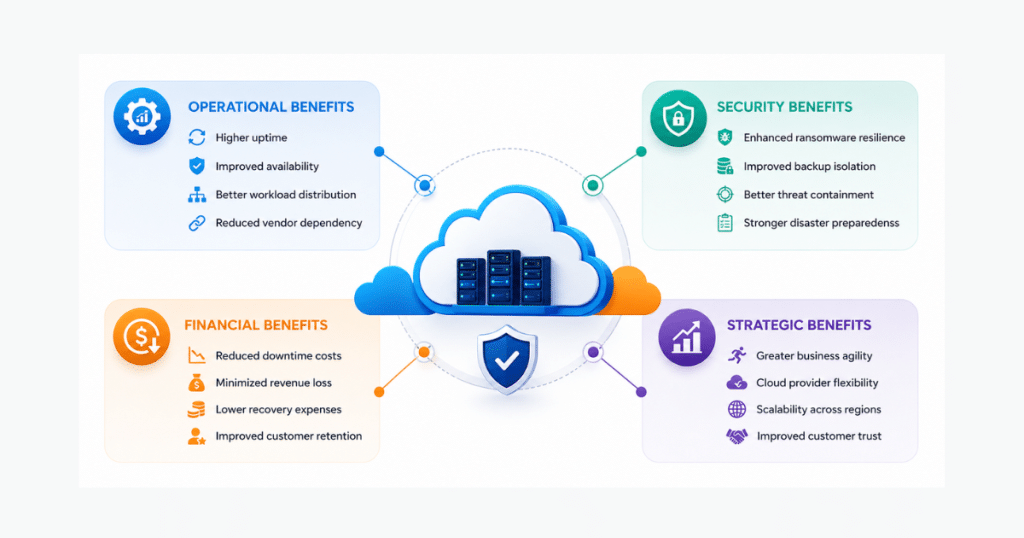
Benefits of Multi-Cloud Disaster Recovery
Operational Benefits
- Higher uptime
- Improved availability
- Better workload distribution
- Reduced vendor dependency
Security Benefits
- Enhanced ransomware resilience
- Improved backup isolation
- Better threat containment
- Stronger disaster preparedness
Financial Benefits
- Reduced downtime costs
- Minimized revenue loss
- Lower recovery expenses
- Improved customer retention
Strategic Benefits
- Greater business agility
- Cloud provider flexibility
- Scalability across regions
- Improved customer trust
How Multi-Cloud Disaster Recovery Works
Step 1: Identify Critical Workloads
Start by identifying:
- Revenue-generating applications
- Customer-facing platforms
- Databases
- ERP systems
- Payment systems
Prioritize workloads based on business impact.
Step 2: Define Recovery Objectives
Establish:
Recovery Time Objective (RTO)
Maximum acceptable downtime.
Recovery Point Objective (RPO)
Maximum acceptable data loss.
These metrics determine backup frequency and recovery architecture.
Step 3: Implement Cross-Cloud Replication
Replicate:
- Virtual machines
- Containers
- Kubernetes workloads
- Databases
- Storage volumes
across multiple cloud environments.
Step 4: Automate Failover
Automated failover ensures traffic shifts instantly to the secondary cloud during outages.
This minimizes manual intervention and accelerates recovery.
Step 5: Test Regularly
Disaster recovery plans should be tested quarterly.
Testing validates:
- Recovery procedures
- Data integrity
- Failover processes
- Team readiness
Real-World Multi-Cloud Disaster Recovery Use Cases
Financial Services
Payment gateways cannot tolerate downtime.
A fintech company replicates transaction systems between AWS and Azure, ensuring uninterrupted payment processing.
Healthcare Organizations
Hospitals require continuous access to patient records.
Multi-cloud replication ensures critical healthcare systems remain operational during outages.
eCommerce Platforms
Online retailers face significant losses during downtime.
Cross-cloud failover keeps websites, payment systems, and inventory platforms running during infrastructure failures.
SaaS Providers
Software providers maintain service-level agreements (SLAs) by leveraging multiple cloud environments for resilience and availability.
Best Practices for Building a Multi-Cloud Disaster Recovery Plan
Create a Recovery Runbook
Document:
- Recovery procedures
- Escalation paths
- Failover processes
- Contact information
Automate Everything Possible
Automation reduces human error and accelerates recovery.
Focus on:
- Infrastructure as Code (IaC)
- Automated backups
- Automated failover
- Automated testing
Encrypt Backup Data
Protect data both:
- At rest
- In transit
Encryption strengthens security and compliance.
Monitor Continuously
Implement proactive monitoring for:
- Replication failures
- Backup success rates
- Storage utilization
- Cloud service health
Test Disaster Recovery Frequently
A recovery plan that has never been tested is merely documentation.
Conduct scheduled simulations and recovery drills.
Future Trends in Multi-Cloud Disaster Recovery
The future of Cloud Infrastructure Management and disaster recovery is becoming increasingly intelligent.
Key trends include:
AI-Driven Disaster Recovery
Artificial Intelligence will predict failures before they occur and automate recovery decisions.
Kubernetes-Based Recovery
Containerized applications will dominate disaster recovery architectures due to portability across cloud providers.
Cyber Recovery Vaults
Organizations are adopting isolated recovery environments to combat ransomware threats.
Zero-Downtime Recovery
Advanced replication technologies are moving businesses closer to continuous availability.
Multi-Region and Multi-Cloud Architectures
Future-ready organizations will combine:
- Multi-cloud
- Multi-region
- Hybrid cloud
for maximum resilience.
Final Verdict
Cloud outages, cyberattacks, and infrastructure failures are no longer rare events. The question is not whether disruption will occur but whether your business can continue operating when it does.
A well-designed Multi-Cloud Disaster Recovery Strategy provides the resilience modern organizations need to protect critical systems, safeguard customer trust, and maintain uninterrupted operations.
Businesses that invest in Cross-Cloud Recovery, Cloud Backup and Recovery, Data Protection, and Business Continuity Planning gain a significant competitive advantage in an increasingly digital world.
Protect Your Business Before Disaster Strikes
Don’t wait for an outage, ransomware attack, or cloud failure to expose weaknesses in your infrastructure.
Geeks Solutions helps organizations design and implement enterprise-grade Multi-Cloud Disaster Recovery, High Availability Solutions, Cloud Infrastructure Management, and Business Continuity Planning strategies that reduce downtime, protect critical data, and ensure rapid recovery when every second matters.
Schedule a disaster recovery assessment today and discover how resilient your cloud infrastructure truly is.
Frequently Asked Questions
Every business needs a multi-cloud disaster recovery strategy because it reduces dependence on a single cloud provider, minimizes downtime, improves business continuity, and ensures critical applications remain available during outages or cyberattacks.
The primary benefits of multi-cloud disaster recovery for enterprises include higher availability, improved data protection, faster recovery times, reduced downtime costs, enhanced compliance, and stronger resilience against cloud provider failures.
To build a multi-cloud disaster recovery plan, organizations should identify critical workloads, define RTO and RPO objectives, implement cross-cloud replication, automate failover processes, continuously monitor systems, and conduct regular disaster recovery testing.
Cloud backup and recovery focuses on storing and restoring data, while multi-cloud disaster recovery ensures complete application, infrastructure, and service recovery across multiple cloud providers with minimal downtime.
Cross-cloud recovery for business continuity planning enables organizations to instantly fail over workloads from one cloud provider to another, ensuring continuous operations during outages, cyberattacks, regional failures, or infrastructure disruptions.