Summary
AI-powered DevOps is redefining how modern businesses manage infrastructure. By combining artificial intelligence with DevOps practices, organizations can predict failures, automate workflows, and improve system reliability. This blog explores how AI in DevOps works, its real-world applications, tools, benefits, and future impact.
Introduction
The world of IT infrastructure is evolving faster than ever. Traditional DevOps practices helped organizations move faster, but today, speed alone is not enough. Systems are becoming more complex, data is growing exponentially, and downtime is more expensive than ever.
This is where AI-powered DevOps comes into play.
By integrating artificial intelligence into DevOps workflows, businesses can move from reactive operations to predictive and automated systems. Instead of waiting for failures, systems can now detect patterns, predict issues, and even fix them automatically.
In simple terms, AI-powered DevOps is not just an upgrade—it’s a transformation.
What is AI-Powered DevOps (AIOps)?
AI-powered DevOps, often referred to as AIOps (Artificial Intelligence for IT Operations), uses machine learning, data analytics, and automation to enhance DevOps processes.
It enables systems to:
- Analyze massive amounts of operational data
- Detect anomalies in real time
- Predict potential failures
- Automate responses without human intervention
Unlike traditional monitoring tools, which rely on predefined rules, AI in DevOps continuously learns and improves from data.
Traditional DevOps vs AI-Powered DevOps
Traditional DevOps
- Reactive monitoring
- Manual troubleshooting
- Rule-based alerts
- Slower incident resolution
AI-Powered DevOps
- Predictive monitoring
- Automated issue resolution
- Intelligent anomaly detection
- Faster root cause analysis
The shift from reactive to predictive operations is what makes AI-powered DevOps a game changer.
How AI-Powered DevOps Works
At its core, AI-powered DevOps works by collecting and analyzing data from multiple sources such as:
- Application logs
- Server metrics
- Network performance
- User behavior
This data is then processed using machine learning algorithms to identify patterns and anomalies.
Key Components:
1. Data Collection – Continuous data gathering from infrastructure and applications.
2. Data Analysis – AI models analyze trends and detect unusual behavior.
3. Prediction – The system forecasts potential failures before they happen.
4. Automation – Automated actions are triggered to resolve issues instantly.
Key Use Cases of AI in DevOps
1. Predictive Failure Detection
One of the most powerful applications of AI-powered DevOps is predicting failures before they occur.
2. Intelligent Monitoring
AI filters noise, prioritizes alerts, and improves efficiency.
3. Automated Incident Response
Systems can restart services, scale resources, or roll back deployments automatically.
4. Root Cause Analysis
AI identifies the exact cause of failures and reduces debugging time.
5. Cost Optimization
AI recommends resource optimization and reduces unnecessary cloud spending.
Security in AI-Powered DevOps
As organizations adopt AI-powered DevOps, security becomes even more critical. With automation handling key operations, vulnerabilities can scale quickly if not managed properly.
AI strengthens security by:
- Detecting unusual behavior in real time
- Identifying threats early
- Automating patches and updates
- Monitoring access patterns
This approach aligns with DevSecOps, where security is integrated directly into the lifecycle. AI in DevOps ensures protection is proactive rather than reactive.
Role of Data in AI-Powered DevOps
Data is the foundation of AI-powered DevOps. Without high-quality data, AI systems cannot deliver accurate insights.
Organizations should focus on:
- Accurate and consistent data collection
- Real-time data processing
- Historical data storage for pattern recognition
Over time, AI in DevOps becomes smarter and more precise, improving operational efficiency.
Continuous Learning and Improvement
One of the biggest advantages of AI-powered DevOps is continuous learning.
AI systems:
- Improve after every incident
- Adapt to changing environments
- Refine predictions over time
This creates a self-improving infrastructure that becomes more resilient with use.
Real-World Example
A leading streaming platform experienced frequent downtime during peak traffic events.
After implementing AI-powered DevOps, they achieved:
- Predictive scaling before traffic spikes
- Automated load balancing
- Real-time anomaly detection
Results:
- 60% reduction in downtime
- 70% faster incident resolution
- Improved user experience
This highlights the real impact of AI in DevOps at scale.
Popular Tools for AI-Powered DevOps
Organizations use various tools to implement AI-powered DevOps, including:
- AI-driven monitoring platforms
- Cloud-native AI services
- Observability tools
The effectiveness depends on proper implementation and integration.
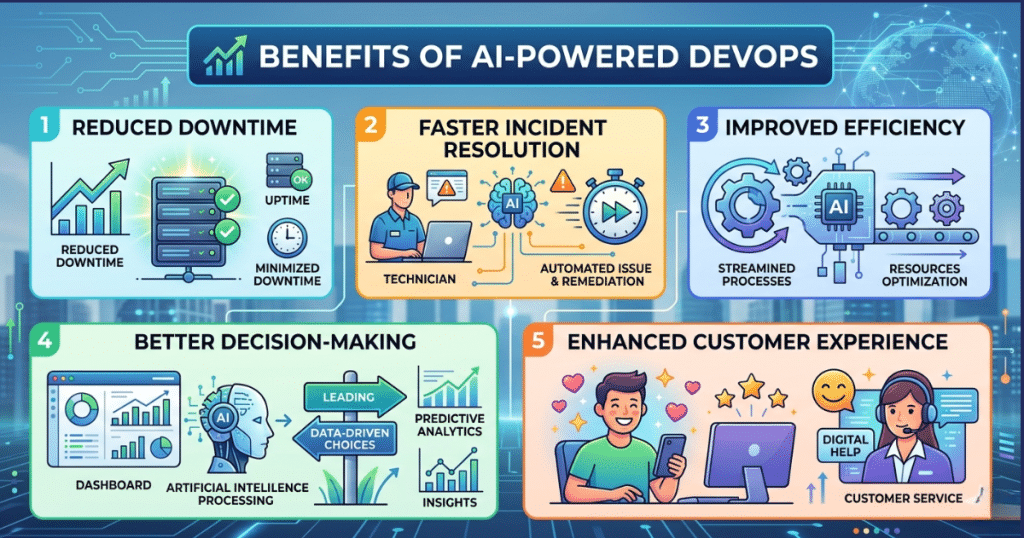
Benefits of AI-Powered DevOps
- Reduced downtime
- Faster incident resolution
- Improved efficiency
- Better decision-making
- Enhanced customer experience
Challenges of AI in DevOps
- Data quality issues
- Implementation complexity
- Skill gaps
- Initial investment
Despite these challenges, AI-powered DevOps delivers long-term value.
Impact on Business Growth
Adopting AI-powered DevOps drives business growth in multiple ways:
Faster Time-to-Market
Automation speeds up releases.
Better Customer Experience
Stable systems improve satisfaction.
Scalability
Infrastructure adapts easily to growth.
Competitive Advantage
Businesses innovate faster using AI in DevOps.
Human + AI Collaboration
AI-powered DevOps does not replace humans—it enhances them.
AI handles repetitive tasks and analysis, while humans focus on strategy and innovation. This collaboration leads to better outcomes and smarter operations.
Best Practices for Adopting AI-Powered DevOps
- Start with a small use case
- Choose the right tools
- Train your team
- Ensure data quality
- Track performance metrics
Future of AI-Powered DevOps
The future includes:
- Self-healing systems
- Fully automated infrastructure
- AI-driven security
- Smarter cloud environments
AI-powered DevOps will soon become a standard for modern IT operations.
Conclusion
AI-powered DevOps is transforming IT operations by combining automation with intelligence. It enables businesses to predict issues, automate responses, and optimize performance.
As systems grow more complex, adopting AI in DevOps is essential for staying competitive. Organizations that embrace this transformation today will lead the future of digital innovation.
CTA
Ready to future-proof your infrastructure? Start adopting AI-powered DevOps today and stay ahead of the competition.
Frequently Asked Questions
AI-powered DevOps combines artificial intelligence with DevOps to automate operations and improve system performance.
It enables predictive monitoring, automation, and faster issue resolution.
Reduced downtime, better efficiency, and improved decision-making.
Yes, it helps improve efficiency and reduce operational costs.
Monitoring tools, observability platforms, and cloud-based AI services.